
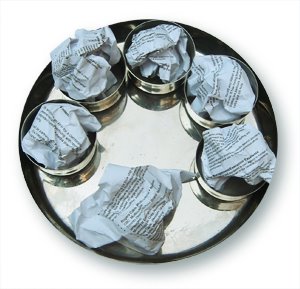
Click on the title of this article to view an excellent interactive map illustrating immigration and mother tongue data from the StatsCan report on the 2006 Census. (Courtesy the Canadian Press, via CBC.)

While checking it out, keep in mind this interesting fact from the 2006 Census:
93.6 per cent of Canadian immigrants can speak either English or French.

It tends to rather put things in perspective.
Not such a tower of Babel, eh?


Article: Creative Commons License 2008 Gavin Barrett

Creative Commons License


This work is licensed under a Creative Commons Attribution-Noncommercial 2.5 Canada License.

The 2006 census shows that between 2001 and 2006:

58.3 per cent of all immigrants came from Asia,
including the Middle East.
16.1 per cent came from Europe.
10.8 per cent came from the Caribbean, and Central and South America.
And 10.6 per cent hailed from Africa.

The foreign-born account for 19.8 per cent of Canada's population,
the highest it has been in 75 years.
Australia is the only country in the world with a higher percentage,
with 22.2 per cent not born in Australia.
The United States' foreign-born population by comparison
is just 12.5 per cent.


Source: StatsCan, Census 2006
Article and pie chart: Creative Commons License 2008 Gavin Barrett

Creative Commons License


This work is licensed under a Creative Commons Attribution-Noncommercial 2.5 Canada License.

More than 200 different ethnic origins were reported in the 2006 Census. 11 ethnic origins have grown beyond one million in population. The largest group was composed of the 10 million people who reported Canadian as their ethnic ancestry, either alone (5.7 million) or with other origins (4.3 million).

Approximately 5,068,100 belong to the visible minority population accounting for 16.2% of the total population of Canada.

Due to the increasing number of recent immigrants from non-European countries, the visible minority population grew faster than the total population. The visible minority population grew at a rate of 27.2%, five times faster than the total which only only grew at 5.4%.

75.0% of all immigrants who arrived between 2001 and 2006 belonged to a visible minority group.

South Asians are now Canada's largest visible minority group, surpassing the Chinese. Both groups are over one million.
An estimated 1,262,900 individuals say they are South Asian, representing one-quarter (24.9%) of all visible minorities, or 4.0% of the total population in Canada. The Chinese accounted for 24.0% of the visible minority population and 3.9% of the total Canadian population. The chart above shows the composition of Canada's visible minorities - the numbers shown are percentages, rounded up.

In the census metropolitan area of Toronto, 42.9 per cent identified themselves as a visible minority and a total of 27.8 per cent of the visible minority population was born in Canada.

South Asians account for 684,070, followed by Chinese 486,325 and black 352,220.


Article and pie chart: Creative Commons License 2008 Gavin Barrett

Creative Commons License


This work is licensed under a Creative Commons Attribution-Noncommercial 2.5 Canada License.
No, it's not Lucy's husband.

Hindi in origin, desi literally means countryman and is used to refer to people and things that are of South Asian origin. If you belong to gen HipHop think of it as the South Asian equivalent of homeboy or homie. It's a derivation of the Hindi word desh which means country. Used between South Asians in much the same way that Italians refer to each other as paisans. It's a handy word because, when used colloquially, it crosses boundaries and groups various South Asian nationalities together.

Article: Creative Commons License 2008 Gavin Barrett

Creative Commons License


This work is licensed under a Creative Commons Attribution-Noncommercial 2.5 Canada License.
Blessed are those who see but do not jump to believe. Click the article title to play this provocative spot by Avion Films' Mike Thompson.

My favourite magazine covering Toronto is Spacing and writer Robin Chubb's excellent series on "Mapping our Urbanism" is a treasure trove of facts and intelligence.
In an article about the GTA's diversity, what caught my eye, though, was the map accompanying it (shown above).
It was created by Catherine Farley and Damian Listar and originally published in the Toronto Star.
It's called "The Language Quilt". You can see why.
Click on my article title to read Robin Chubb's article at Spacing.ca


Article: Creative Commons License 2008 Gavin Barrett

Creative Commons License


This work is licensed under a Creative Commons Attribution-Noncommercial 2.5 Canada License.

When I was still a child, I was asked to write the relaunch campaign for Red Eveready, India's biggest battery brand. (Shown with this article: an ad from that campaign.)
I don't know why.

The campaign ran for 13 years.
I don't know why.

It was apparently very successful.
I don't know why.

It appears they teach it in business school in India.
I don't know why.

DesiCreative.com recently wanted to interview me about this campaign.
I don't know why.

But I do know where the interview is.
Click on the article title to read it at desicreative.com, which by the way is an excellent site for anybody interested in the new wave of Indian creative talent.

The art director who worked with me on this campaign was Sharad Nigvekar and he did a splendid job.
Kasa aahe Sharad?


Article and image of advertisement: Creative Commons License 2008 Gavin Barrett

Creative Commons License


This work is licensed under a Creative Commons Attribution-Noncommercial 2.5 Canada License.

All other copyrights are the property of their respective owners.

Once again I am in debt to Harper's, without a doubt the best damn magazine in the world.

In the February 2008 Harper's Index I discovered that Shaadi.com, an immensely popular matchmaking site for South Asians (or "matrimonials site", as we beige folk like to say) allows listees to choose from no less than six skin tones and 275 castes.

I poked around the site and discovered they also offer a menu of 28 communities and 67 mother tongues.

Does this make it impossible to choose a mate? Far from it.

Shaadi.com estimates it has made between 800,000 and a million successful "matches".
It has over 10 million members, numbers that make it one of the most successful and most admired online companies in all of Asia.

It even lets you search for matches in the USA and Canada.

Now you know where to look if you're in the market for a wheaten complexion male Iyengar Brahmin MIT engineer with a green card or a very fair, tall Sikh lady doctor coming from a very respectable family based in Malton, Ontario.

And oh, every single shaadi.com page is in English.


Article: Creative Commons License 2008 Gavin Barrett

Creative Commons License


This work is licensed under a Creative Commons Attribution-Noncommercial 2.5 Canada License.

photo of mehndi at Indian wedding: by Riffat, via flickr
Some rights reserved.
Cantonese pop music.
Dominated by the Four Kings (Jackie Cheung, Leon Lai, Aaron Kwok and Andy Lau) in the 90s.
Current stars include scandal-tainted Gillian Chung.


Article: Creative Commons License 2008 Gavin Barrett

Creative Commons License


This work is licensed under a Creative Commons Attribution-Noncommercial 2.5 Canada License.


Meaning Chinese outside, white inside.

Pejorative.

Usually employed by Chinese-Canadians to describe some second generation (or, occasionally, first generation) Chinese-Canadians (or -Americans or -Brits) who are thought to have lost too much of their culture or language.

Like coconuts, a banana typically hangs with other bananas, and often does not speak any Chinese.

Article: Creative Commons License 2008 Gavin Barrett

Creative Commons License


This work is licensed under a Creative Commons Attribution-Noncommercial 2.5 Canada License.

Meaning brown outside, white inside.

Pejorative.

Usually employed by Indo-Canadians to describe some second generation (or, occasionally, first generation) Indo-Canadians
(or -Americans or -Brits) who are thought to have lost too much of their Indianness.

A coconut typically has few Indian friends besides other coconuts, and often does not speak any Indian language.

Article: Creative Commons License 2008 Gavin Barrett

Creative Commons License


This work is licensed under a Creative Commons Attribution-Noncommercial 2.5 Canada License.
Welcome to a new category in this blog.
The world's first Multicultural Glossary.

A handy-dandy web guide to meanings of mots multicultural.

Jibes, jive talking, jargon.
Patois, politically incorrect perambulations, pejoratives.
In jokes, insider speak.
I hope to cover it all.
A sort of baatcheat sheet.

And now, before we move on to the first word, some politically incorrect comic relief, just to show you how serious I am about keeping promises. Also, I think it rather makes the point about the need for a glossary.


Article: Creative Commons License 2008 Gavin Barrett

Creative Commons License


This work is licensed under a Creative Commons Attribution-Noncommercial 2.5 Canada License.


Multicultural TV work done by Barrett and Welsh.


A Bollywood villain runs up against a far greater power than himself: a remote control. A TV spot for Rogers Bollywood Oye! video on demand service from Barrett and Welsh. Directed by Robert Maya of Mad Films for Barrett and Welsh.

text copyright 2008 Gavin Barrett All rights reserved
Click on the title of this post to read a great article by Nicholas Keung that appeared in The Toronto Star.
The piece reviews the findings of an important new study into the media consumption habits of Canada's largest minority groups and whether the country's major advertisers are actually reaching this gigantic market. It's worth noting that fifty-two per cent of the people surveyed said, "I rarely see advertising messages intended for me."


copyright 2006 Gavin Barrett All rights reserved
Click on the title above and watch the spots on YouTube.
The spots (some of them award winners) cover a total of 6 languages:
Cantonese, Mandarin, Punjabi, Tamil, Hindi and English.
Enjoy.
This Nike Cricket spot is directed by Abhinay Deo with whom we have a tie-up for production in India. Abhinay is a Cannes award-winning director (it's easy to see why) and he made this spot for JWT India.

The national creative director at JWT is Agnelo Dias, a talented, quiet-spoken gentleman for whom I have a lot of time.

Talk about being on the right wavelength.
This spot hits all the right buttons.

Want to know why? Send me a note and I'll tell you.

The New York Times calls this London-based Sri-Lankan rappergirl's latest hit and accompanying video "electrifying" and "pure, surreal rhythm." M.I.A., I tip my turban to ya. Word.

Click on the article title to see the video on YouTube.

MULTICULTURAL MARKETING SECRET #3.
SOMETIMES THEIR NATIVE TONGUE IS OUR NATIVE TONGUE.

As always, in the complex world of multicultural communications, there's more than one side to multiple language communications.

In some cases, English is still your best bet - though not the Queen's variety, perhaps.
International variants whether patois, pidgin or dialect possess colour, immediacy and spirit that make them instantly accessible to your audience

The English themselves employ this with great effect.
Consider I could doon a broon.
A tremendously successful slogan for Newcastle Brown, in dialect known to Geordies everywhere.
(Psst: know of others? Send in your entries.)

For our South Asian audiences, we usually recommend the use of English-only ads because our audience’s familiarity with the language cannot be underestimated.

It is worth noting that India by itself, has more English speakers than any other country in the world.
English is India’s language of business, government and law and is the language that straddles the linguistic divide between North and South Indian languages. Over 2.4 million people read the Times of India daily.

And when one considers that there are 23 official languages, 12 of which are represented on the country's currency. It seems more like a mind-boggling tower of babel than a market.

Yet, major advertisers in India have typically solved this problem with simple efficiency: they run their ads in English.
Oh yes, when they know their markets, and can afford multiple language buys in regional newspapers and so on, they do run advertising in the regional language(s) too. But typically, English leads.

It might be worth taking a leaf out of that book. A market study we conducted with Professor Dilip Soman at the University of Toronto's Marketing Faculty, taught us that many immigrants from these groups were offended when marketers chose to speak to them in their native tongues. For these English-medium highly educated, often multilingual new Canadians, it felt vaguely patronising. Not a good place to begin a relationship methinks.

text copyright 2008 Gavin Barrett All rights reserved
Image: Bangles in Laad Bazaar, Hyderabad, Andhra Pradesh, India. The fixed price signs indicate that there is no bargaining allowed, in, from left, Urdu, Hindi, Arabic and English. Photo taken by David Boyk in 2003. Image licensed under Creative Commons Attribution 1.0 License.


A corollary to Secret#2 aka WHAT'S THE FREQUENCY KENNETH WONG?

We've now established (in #2) that speaking to an audience requires more than speaking the same language.
Rather, it has to do with communicating on the same wavelength.

Here's the corollary: this does not exclude communications in those languages.

Sometimes, simple practicality determines that an ad for a Punjabi-only audience be in Punjabi.
Or that a poster that will appear at a Lebanese festival be in Arabic.
And yes, most advertising targeted at Chinese audiences will run in a Chinese language, whether Cantonese or Mandarin.

This is often the case when you are trying to reach larger groups of first generation blue collar immigrants, for instance.

It is (culture) relevance that allows a brand to communicate effectively, to engage.

Language only makes it possible.


copyright 2007 Gavin Barrett All rights reserved
picture: Mai Dang Lao (McDonald's in Chinese), bronze fangding ritual sculpture by Zhang Hongtu

The second critical factor when attempting to engage a multicultural audience is language.
Seems obvious, doesn't it? But wait, here's the secret.

MULTICULTURAL MARKETING SECRET #2: DON'T SPEAK TO THEM IN THEIR LANGUAGE. SPEAK TO THEM IN THE RIGHT LANGUAGE.

Before you can get under someone’s skin you’ve got to live in their skin.
In other words, understand their psychographics.
Get on the same bandwidth.

This approach requires open-mindedness, an appetite for cultural nuance and subtlety, a love of challenge. But it can be done.
To borrow the words of the great Hollies song, he ain't heavy, he's my brother.

Much is made of the cultural differences between various ethnic groups in Canada. Chinese market experts tout their expertise in reaching their fellow immigrants. South Asian market experts flaunt theirs.

Meanwhile, south of the 44th parallel, the Hispanic population has outstripped the African American population. Though one might think this would establish the position of Hispanics in the mainstream, advertising agencies and marketers are spending vast amounts of time and brainpower to say that only a Hispanic agency can produce messaging that will connect with this powerful new audience effectively. It’s an old idea. It’s a well-used idea. It’s an idea whose time has gone.

There is one way to reach a minority audience. To connect, to engage, to be significant, one has to understand what it feels like to be that minority.

“Ich bin ein Berliner” said JFK (unfortunately claiming kinship with a sausage in the process – but we know what he meant).
“I am a Berliner. I am one of you. I too live with the Wall. I feel your pain at being separated from your countrymen.”
The brilliance of the line, of the sentiment, was not one of timing important as it was. Its brilliance lies in empathy.

You aren't heavy if you're my brother.

The door to the mind of a Chinese housewife in Mongkok, Hong Kong or in Agincourt, in the GTA is the same.
And it takes the same key to open it.
That very key also opens the door into the mind of a Tamil accountant in Matunga, Mumbai or in Cedarbrae, Scarborough.

That key is openness. Openness is all. So, marketers, are you?
No habla multiculturalese? You're screwed.


copyright 2007 Gavin Barrett All rights reserved

Right. This posting picks up where the "...Stoopid" posting left off. So how do you talk to the multicultural market without pissing anyone off? Here it is. For free. No holds barred. Nothing hidden. Nothing held back. A drum roll please, for step one:

MULTICULTURAL MARKETING SECRET #1: SPEAK BRAND TO ME

or, to put it another way

MAINTAIN BRAND FIDELITY


That's right. We tell all our clients that any multicultural advertising they do should bear a strong resemblance to the brand work they are currently running in the mainstream. We find our clients tremendously relieved to hear this.

The truth is, if you've created a brand you have already created an idea of who you are in the public space. A relationship exists. For a multicultural audience, you now need to explain that relationship in a culturally relevant fashion. But you don't have to change who you are to do it.

We know that this works from experience. Here's why:

A.
It reinforces your brand in the advertising; in other words the advertising helps your brand while doing the job it needs to do.

It reinforces your advertising by linking it to your brand (which already lives in the public space); in other words your brand helps your advertising do its job.

B.
In addition, it prevents the alienation of ethnic audiences, who are hypersensitive to obviously “segregated” approaches.
This seems paradoxical, but it is simpler to understand when we put it in the words of a multicultural consumer.
"Treat me the same, but understand my differences."

C.
Our approach is very much in keeping with best practices in ethnic marketing. Case studies of ethnic campaigns that correctly engage their audiences while maintaining brand fidelity are aplenty. (Rogers, Telus, Bank of America).
For a company devoted to establishing what the best practices are in a nascent industry, this sounds like a waffle. It isn't.
A good idea is a good idea even if it's someone else's - in the case of Rogers though, it was ours.


copyright 2006 Gavin Barrett All rights reserved
A short Eid wish from us.
Click on "Eid Mubarak" (above) to view the greeting.


Because it is better to have an idea than to curse the multicultural market with more darkness.
A short Diwali wish from us, Click on Shubh Labh (above) to view the greeting.


Because it is better to have an idea than to curse the multicultural market with more darkness.
You don't have to speak to us slowly. Or loudly. We're not dumb. Or deaf.

Yet, for some reason, majority culture marketers often assume that visible minorities are, gosh darn it, stoopid.

Now these aren't bad people. They even mean well. They really do want to connect with minority markets.
But, as with so many well-educated anglophone North Americans, ethnocentrism gets in the way.

"They won't understand."
"That's a lovely idea but it's too clever for this audience."

If only they knew. Here's the thing. Ethnic audiences in Canada and the USA are dominated by the post 1990 immigrant phenomenon. These immigrants are well-educated, well-travelled professionals - an affluent white collar audience who must be treated as such.

There is still more to it. These are audiences who have seen their home economies change overnight.
The changes have been radical. Their impact has been global.

The middle class markets that have sprung up in India and China, are surprisingly subtle and sophisticated.

South Asian and Chinese immigrants are exposed to advertising in their home countries that is in many ways more sophisticated than mainstream Canadian advertising. (Watch this blog for great advertising from those markets - it will blow you away, I promise.)

In other words, ethnic audiences are not simple-minded. They do not require simpler messages. In fact they often take offence when treated in this fashion.

These audiences come from ancient cultures and are accustomed to incredibly complex forms of communication. They handle subtlety and nuance to a degree rarely understood by western minds.

So, how should you, as a marketer speak to these markets? More on that after my Diwali and Eid postings.


copyright 2006 Gavin Barrett All rights reserved
For the last 21 years I have been privy to the tone-und-style diktats of some the largest brands in the known universe.

These brand guidelines or style guidelines or brand documents, as they have been variously and unimaginatively called, were written by some of the most august, venerable touts of branding in the world - great names writing about great names hoping to make a still greater name for themselves.

There was a common denominator in almost all of these documents.
They specified that the brand voice must be Approachable.

Approachable!

Which moron wrote that?
Has there been a commercial venture since the beginning of time that wanted to be unapproachable?

Approachability has been the core of every act of commerce, from the oldest profession in the world to the youngest. Approachability is about what makes you friendly (don't get me started on that word!) and accessible.
Anyone who is selling anything wants to be friendly and accessible.
Butchers. Bakers. Candlestick makers.
Whores. Priests. Doctors. Clairvoyants. Snake oil salesmen. Arms dealers. Pushers.
They all want you to be able to find them, and, having found them, to like the experience of dealing with them enough to want to come back for more.
(There are exceptions and we will come to those another time.)

Approachable!
A pedestrian crossing is approachable.
A pedestrian crossing is also, well, pedestrian.


copyright 2006 Gavin Barrett All rights reserved
A recent Marketing Magazine issue interviewed research maven Kaan Yigit on how the increase in our multicultural population will affect banks and their marketing.

“The growth of major ethnic cultural groups has been quite rapid in the past 10 years and it will continue for the next 10,” said Kaan, director of Solutions Research Group’s new Diversity in Canada study. “Every 10 years, you’re looking at 2.5 million new immigrants. That’s a lot of people with no brand preference–they don’t know one bank from the next."

Think about it. 2.5 million people.
A population the size of Toronto, every ten years. A population that will need to borrow to finance a new life.

That's a whole lot of new homes, new cars, new kids in school.
That's a whole lot of money in the pipeline.
Mortgages. Car loans. RESPs. Student loans.

The immigrant class Canada attracts is well-educated, professional, equipped with a strong work ethic and a fairly sophisticated world view. For immigrants, bad debts have a cultural stigma associated with them. In other words, to a bank, immigration provides a tide of well-behaved, low-risk customers.

So are Canada's banks making their presence felt among new Canadians?
Actually, the silence is deafening.

Name one bank RESP campaign that is based on the insight that South Asians and Chinese place a very high value on education. Or name an ad that leverages the cultural tendency to save and invest.

One thing banks seem to execute effectively enough is what I call the "insert-visible-minority-here" (IVMH to friends) strategy. It's better than nothing I suppose. IVMH is itself a relatively new phenomenon, accounting for the sudden appearance (c. 2002) of multiple ethnicities in bank advertising. Advertising that until then, had been - how to say this delicately? - colourless.

And now? Surely they've learned?
Oh no. Banks continue to offer the same insipid generic products.
Bank multicultural communications seem to be limited to meaningless sponsorships at random cultural events.
And the absence of cultural insight in bank advertising means that when anything is said, it is sans resonance, sans relevance, and alas, absolutely sans colour.

“Whoever reaches a little bit more deeply, with a little bit more enthusiasm, and perhaps makes sense of (immigrants’) life stages or cultural context, is going to have a bit of an edge.” said Mr Yigit to Marketing Magazine.

I said something very similar to Strategy Magazine when it came out with a multicultural issue - a full five years ago.
I guess the banks just can't understand our accents Mr Yigit.


copyright 2006 Gavin Barrett All rights reserved
Received some feedback that my posting titled "Where do we come from" required some clarification.

It's all very well having multiculturalism in your DNA when you were born into a fragmented 300 language market.
But how does it actually work?
How do you advertise to multicultural audiences in a predominantly anglophone or francophone society?

You asked.

When we work on a multicultural campaign, we start with anthropological, observation-based research.
We identify the habits and patterns our target audiences have formed since arriving in Canada.
We isolate their motivators and stumbling blocks. We observe them closely, as they live, where they live – at home, in malls, in chat rooms, at events. How closely do we watch them? If they sneeze, we’re there to say gesundheit.

In short, we look hard at our consumers. We listen hard to what they say.
We think hard about what will motivate them most.
And we work hard to produce the best advertising.

It’s easy really.


copyright 2006 Gavin Barrett All rights reserved
What on earth is a Bheja Bazaar?

Bheja is the Hindi word for brains.
Bazaar is the Hindi word for market.

So, Bheja Bazaar, my multicultural amigos, is a market for brains.
Or to look at it another way, it's brains, for market.

Grey sells.


copyright 2006 Gavin Barrett All rights reserved

Just recently, I was confronted with two questions
"Where do you come from?"
And "Where are you headquartered?"

Barrett and Welsh is headquartered in Toronto, Canada.
We have roving branch offices in dim sum restaurants, bubble tea parlours, kabab houses, dosa palaces, Turkish cafes and roti huts.
We have affiliates in Vancouver, Washington D.C., New York, Mumbai (India), Hong Kong and Dubai.
We have ideas in bathtubs, backyards, bedrooms and cars.
(Not to mention elevators and lifts, apartments and flats.)

We were established as a full-service agency in 2004.
Before that we operated as a creative consultancy, serving some of Canada’s largest agencies.
Our Mom was a Mughal queen. Our Dad was Genghis Khan.

And where do we come from?
Bombay. Hong Kong. Delhi. Singapore. London. Toronto. Calabria. Berlin. Beijing. Palermo. Next door. Faraway. Neverneverland. Narnia. Bollywood.

Or to look at our origins another way. we were appalled by the poor quality of advertising Canada's ethnic markets are faced with - produced mostly by ‘translator agencies’. We wanted to change all that.

And that, dearly beloved, is where we come from.


copyright 2006 Gavin Barrett All rights reserved

There has been some discussion in marketing circles about Chinese consumers being closer to their own heritage and culture than South Asians. It's not a defensible argument.

Is Alice, a Mandarin-speaking dollar-store-owning-mum, closer to her own mainland Chinese culture?
Or is Gurpreet - an English-speaking Punjabi-sweets-and-samosa-takeout-owning-mum closer to her roots in Punjab?

Who feels more connected to her homeland or her ethnic origins?

Let's look at Alice, married, with two kids; she celebrates the Chinese New Year, speaks Mandarin at home, reads the Mandarin newspaper, watches Mandarin TV and sends her kids to extra Chinese language classes and ballet, but is Catholic (the largest single religious denomination among Chinese immigrants in the Greater Toronto Area) and hopes her children will find Chinese mates for themselves when they grow up.

And Gurpreet? Also married, with two kids, she celebrates Baisakhi, shares her home with at least one set of in-laws, speaks a combination of Punjabi and English at home, reads the Toronto Star, occasionally picks up a free Indian newspaper, usually in English, watches Omni and English TV, goes to the gurdwara religiously (and takes her kids with her), attends several picnics and Punjabi reunions with her family and is already thinking of what will be the best possible way to arrange a marriage for her kids.

To sum up: It's true that the Chinese simply cannot access mainstream Canadian culture with the same ease that South Asians do. However this does not automatically make the Chinese closer to their own culture than South Asians are to theirs.
It's only true that the Chinese are more isolated from the mainstream by the barrier of language.

Successful marketing to these audiences is a matter of cultural insight, not of language.
(It's the same approach that works in the mainstream after all).
If we connect with them in their own language, sure, they'll hear us.
But if we connect with them on their own wavelength, they'll actually listen to us.

Language may help you get your foot in the door.
Understanding, on the other hand, will get you invited to dinner.
And that, my friends, is where the gravy is.


copyright 2005 Gavin Barrett All rights reserved.


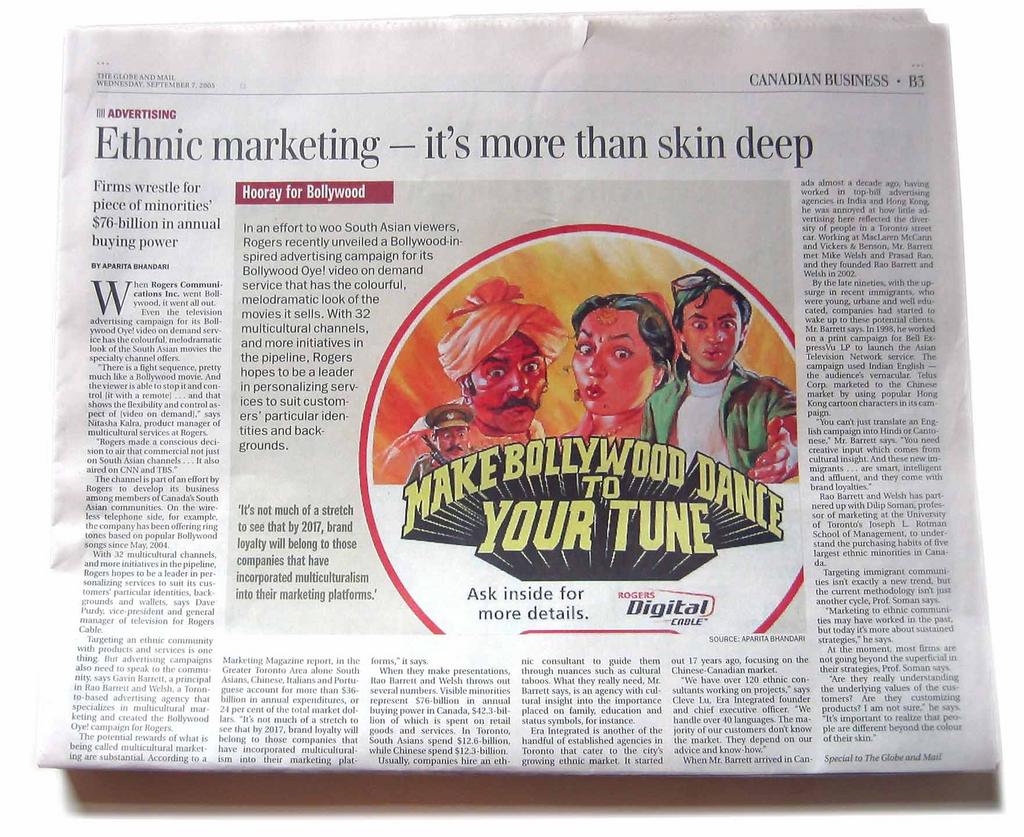
For our award-winning Rogers Bollywood Oye! campaign, there certainly seems to be life after advertising. The Globe and Mail, Canada’s national newspaper featured our work front and centre in this prominent, insightful article on multicultural marketing by Aparita Bhandari. Our strategic and creative leadership was amply on display. And our clients were quoted, yet again. It appears this is a campaign destined for recognition — it has just picked up a couple of gold awards at Promax and C-TAM — shows that celebrate the world’s best marketing work in the cable, television and entertainment businesses. Want to know what the article said? Email Gavin Barrett at gavin@barrettandwelsh.com and he’ll send you the text.
Brands began as marks burned onto rumps of rawhide.
Many brands are still that today, and, often enough, even less than that:
just marks minus the life they were imprinted on.

The most successful brands step beyond the boundaries imposed by design.

Even in intellectual property law a brand is no longer just mark or a unit of design.

In fact, a brand is as much about a logo or mark, as a marriage is about a wedding.

Logos and weddings represent nothing more than beginnings.
Whereas brands and marriages represent the continuum. They represent relationship.

Today's brand, is exactly that: a relationship.
And all good relationships are built on communication.

The moment a brand leaves the chapel of design and crosses the threshold into communication,
it stops looking in the mirror and saying, "I, brand."

It instead begins looking at you, the consumer and says "Us, brand."


More blogs about Advertising.
Technorati Blog Finder

More blogs about Marketing.
Technorati Blog Finder

More blogs about Multicultural Marketing.
Welcome to our multcult marketing adventures.

The things we've done, heard about, and heard done to others.

We hope to serve a dim sum feast of derring-do, a ghotala of gumption.
Those who get it will be held up. Those who don't will be yelled down.

Welcome to Bheja Bazaar.

It's located at the intersection of knowledge and je ne sais quoi.
Where menudo meets vindaloo. Where turbans meet kilts.
Where political correctness meets the Grim Reaper.

If you have a bowlful of rice to throw into the congee, be our guest.
If you have gunpowder for the pepper water, sau putr ho.

Bring your hoary old stories, you storied old whores.
Bring your tired, your weary, your multicultural cliches.

Bring your brains.

Step right in.
Mabuhay. Swagatam.

Gavin Barrett
www.barrettandwelsh.com

Popular Posts

Copyright Gavin Barrett. Powered by Blogger.

Plagiarism Watch!

Protected by Copyscape DMCA Copyright Protection